

Africa’s Missing Variable: Models, Not Resources

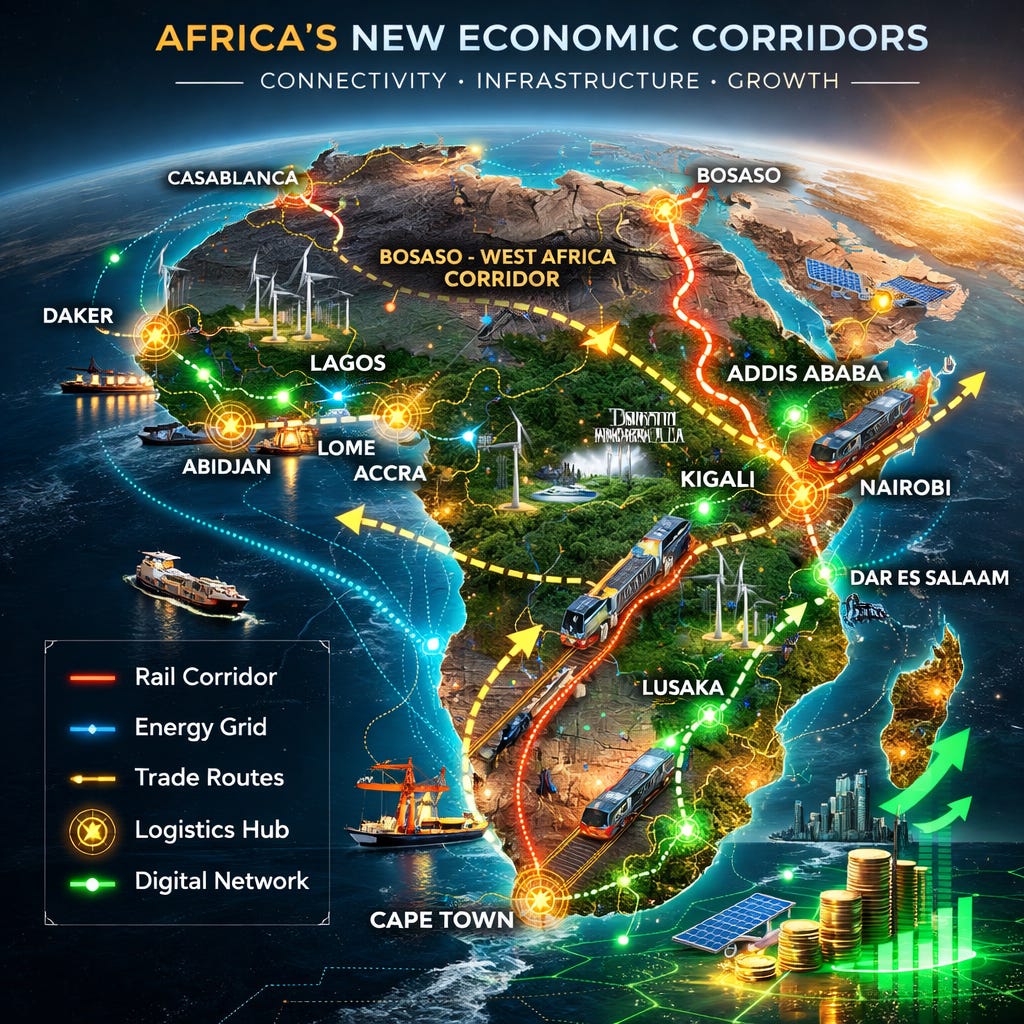
The fundamental challenge Africa has long faced is not a lack of resources, ambition, or labor—but the absence of indigenous, workable political and economic models designed for the continent itself. Without models optimized for Africa’s scale, geography, and social realities, efficiency has remained elusive. And without efficiency, sustained economic growth is structurally impossible.
Africa’s vast size and diversity magnify inefficiencies. Political weaknesses routinely spill into economic ones: fragmented governance raises transaction costs, delays infrastructure, and traps capital in unproductive forms—especially inventory and logistics buffers that exist only because delivery is slow and unreliable.
Yet this was not accidental.
For decades, Western economies exported inefficiencies into Africa while keeping high-value activities—capital allocation, finance, technology, and standards—within their own systems. Africa was positioned as a supplier of raw materials, not as an industrial competitor. At the same time, the West shifted toward financialization, outsourcing labor-intensive manufacturing to Asia. That decision allowed Eastern economies to climb the value chain, reinvest in infrastructure and education, and industrialize—while Africa remained structurally frozen.
The result was a global imbalance: Asia industrialized without resources; Africa had resources without industrialization.
Why the Old System Is Breaking
That strategy is now backfiring.
Western economies are attempting to reshore production just as they face an aging population and mass retirement. Over the next decade, tens of millions of baby boomers will move from capital contributors to capital drawers. Pension funds—once imagined as the backbone of reshoring finance—are increasingly constrained by payout obligations rather than flush with deployable capital.
In theory, governments can attempt leverage schemes—one public dollar attracting multiple private or pension dollars. In practice, demographic pressure limits how much long-duration, low-return industrial capital pension systems can absorb. The timing is wrong.
Meanwhile, China is already deep into its next transition: automation. But automation is not cheap, nor is it simple. It requires an entire industrial ecosystem—robotics manufacturing, sensors, semiconductors, software, data centers, cloud infrastructure, and massive energy expansion. China already produces more energy than it consumes, yet automation will require even more.
This is not incremental change; it is another industrial revolution.
And it carries a deeper contradiction: automation produces output, not consumers. Robots do not eat, drink, buy homes, or generate demand. An economy optimized solely for automated production risks undermining its own consumption base. Productivity without consumers is not growth—it is imbalance.
Africa’s Window Opens
Africa, paradoxically, is entering this transition from a different angle—and that is its advantage.
As indigenous models begin to emerge—whether in Rwanda, Ethiopia, or parts of the Sahel—the continent is starting to invest not reactively, but strategically. Large-scale projects like Ethiopia’s Renaissance Dam or energy development in Ogaden are not isolated bets; they are signals of model formation.
Infrastructure is the real multiplier.
Projects such as a logistics and rail corridor from Bosaso to West Africa would compress delivery times across the continent. Faster delivery does more than move goods—it releases capital. When firms no longer need to hold months of inventory as insurance against delays, enormous amounts of capital are freed for reinvestment, expansion, and innovation.
This is how economies accelerate quietly: not through slogans, but through reduced friction.
The Flywheel Effect
Once logistics improve and delivery times fall, capital velocity rises. As capital velocity rises, productivity increases. As productivity increases, industrialization becomes self-reinforcing. Africa’s resources can finally be processed locally, value can be retained domestically, and revenues can be recycled into further infrastructure and human capital.
This creates a flywheel the continent has never fully activated.
The crucial point is this: Africa does not need to copy the West or China. It needs one or two successful, scalable models that others can adapt. Once a working template exists, imitation becomes organic. Confidence follows structure.
Ironically, the same global system that once kept Africa dependent has now constrained the very powers that built it. While Western economies wrestle with demographic drag and capital scarcity, Africa—long denied industrialization—now has the demographic depth, resource base, and strategic timing to build on its own terms.
This is not a prediction.
It is a structural opening.
If Africa gets the models right, the rest follows.