

Uncharted Horizons
China’s Next Frontier in Africa’s Rise

Most analysis of China begins with ideology.
Most analysis of Africa begins with deficiency.
Both miss the point.
What drives history forward is neither belief nor benevolence, but pressure. Economic pressure. Demographic pressure. Balance-sheet pressure. Empires do not expand because they want to. They expand because their existing models stop working.
China is approaching that moment.
Not collapse. Not crisis. But saturation.
For forty years, China’s growth model followed a single, brutal logic: produce more than you consume, export the surplus, reinvest the gains, and defer household comfort in exchange for national momentum. It worked extraordinarily well. But models that rely on suppression, discipline, and surplus only function while growth remains visibly continuous.
And growth is not just an economic number in China.
It is a psychological stabilizer.
The Fragility Beneath the Surplus
China’s surplus does not belong to the state in the abstract. It belongs to households, firms, and local entities operating in a system without a comprehensive social safety net. High savings are not cultural—they are defensive.
As long as growth holds at 4–5 percent, that surplus stays productive. It circulates through property, business investment, manufacturing, and financial assets. Confidence remains intact.
But the moment growth visibly deteriorates, behavior changes.
Households do not wait for macro explanations. They move instinctively: into gold, into foreign assets, into capital preservation. Consumption slows not because incomes vanish, but because fear enters the system. And once fear spreads, surplus evaporates faster than any state can control.
This is the real constraint China faces.
Exports can no longer guarantee momentum.
Domestic consumption cannot rise without dismantling structural insecurity.
And a full welfare-state solution would require trillions over a decade—politically stabilizing, but fiscally suffocating.
China does not have the luxury of stagnation. It must keep the engine running without overheating its own foundations.
So the question becomes unavoidable:
Where can China redirect surplus without igniting domestic imbalance?
Why Africa Is Not a Choice, but a Geometry
Africa is often framed as a strategic ambition.
In reality, it is a structural necessity.
It is the only remaining demographic and economic space large enough, young enough, and under-consuming enough to absorb externalized surplus at scale.
China’s challenge is not production—it is demand. Africa’s challenge is not population—it is productive capacity. These two pressures align almost perfectly.
This is not empire-building in the classical sense. It is not about flags or dominance. It is about exporting savings and importing demand without destabilizing the home system.
In effect, Africa offers China something it cannot build internally without enormous cost: an external consumption frontier.
But this only works if Africa itself is changing.
Africa’s Quiet Shift: From Fragmentation to Models
For decades, Africa’s core limitation was not resources or people—it was replication. Growth existed, but it did not travel. No internal models were strong enough, fast enough, or independent enough to inspire continental momentum.
That is beginning to change.
The Sahel region, long dismissed as permanently unstable, has started to generate its own political and economic logic—one less dependent on Western patronage and more rooted in sovereignty, regional coordination, and internal legitimacy. Figures emerging from these shifts have gained real resonance across the African diaspora, not because they echo foreign frameworks, but because they signal autonomy.
This matters enormously.
Once a continent begins producing its own reference models—however imperfect—its internal confidence compounds. Policy becomes less imitative. Negotiation power increases. External capital becomes a tool, not a leash.
Africa is not unified. It is not frictionless. But it is no longer ideologically frozen.
And that changes China’s risk calculus.
The Declining Shadow of Western Intervention
For years, China hesitated not because Africa lacked potential, but because geopolitical interference carried unpredictable costs. Regime pressure, sanctions risk, and diplomatic instability made long-horizon investments fragile.
That environment is shifting.
The United States has demonstrated—through withdrawal, neglect, and strategic prioritization elsewhere—that it no longer has the appetite to police political outcomes across Africa. Its inability or unwillingness to maintain influence in regions like the Sahel signals something deeper: intervention is no longer economically sustainable.
This does not mean the West is irrelevant. It means its leverage is thinner.
Africa today operates with greater geopolitical breathing room than at any point in the post-Cold War era. That autonomy reduces the political risk premium for long-term industrial capital.
For China, this is decisive.
Not because conflict with the U.S. is imminent—it isn’t—but because the absence of confrontation lowers the cost of commitment.
The Real Pivot: Externalizing Stability
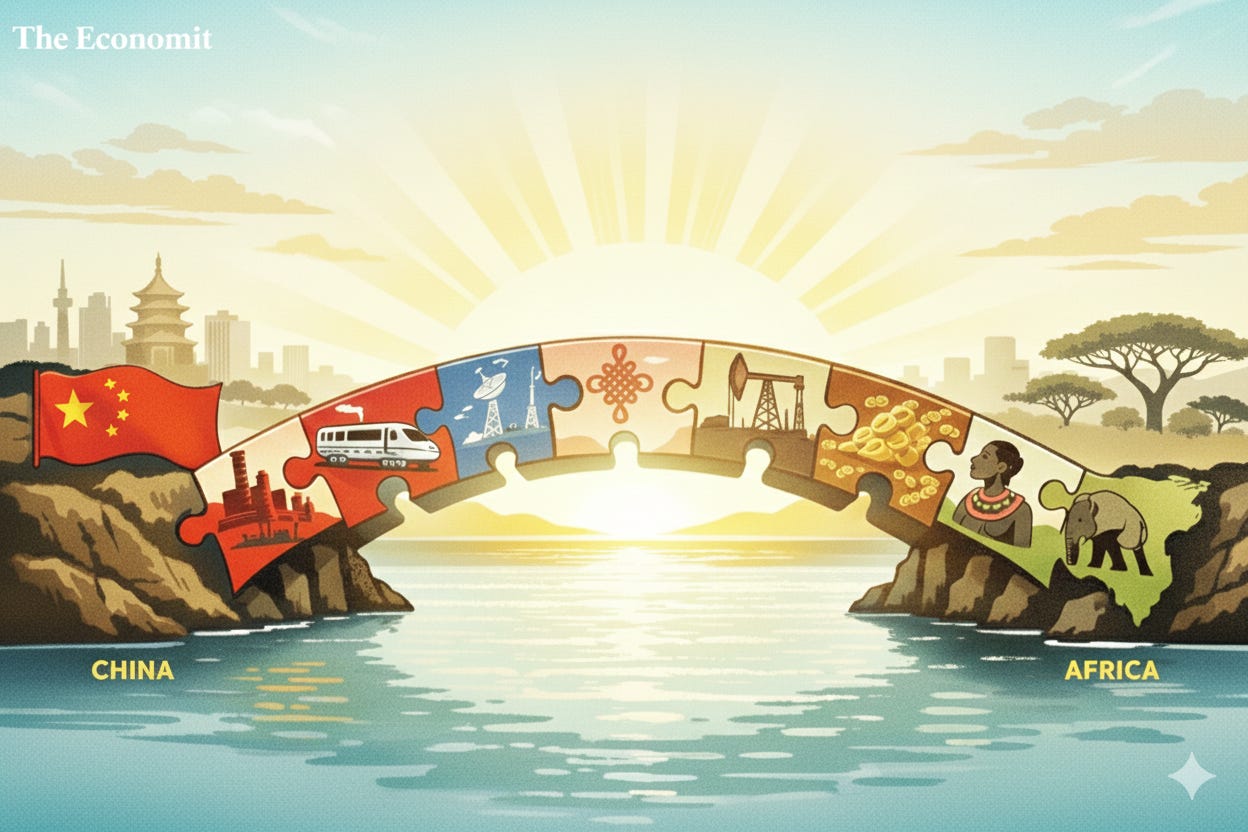
China’s move toward Africa should not be read as expansion. It should be read as balance-sheet management.
By relocating labor-intensive production, financing industrial ecosystems, and gradually underwriting demand outside its borders, China can stabilize growth at home without dismantling its internal social structure.
Africa, in turn, gains manufacturing depth, employment, infrastructure, and bargaining power—provided it sequences intelligently and avoids debt monoculture.
This is not guaranteed success. Currency mismatch, absorption limits, and governance capacity remain real constraints. But these are engineering problems, not conceptual flaws.
What matters is alignment.
China needs continuity.
Africa needs scale.
The moment both recognize this symbiosis, momentum becomes self-reinforcing.
The Horizon Ahead
History rarely announces turning points loudly. It shifts quietly, then all at once.
China’s internal savannah is no longer infinite.
Africa’s external frontier is no longer inert.
The convergence of these realities does not guarantee harmony. But it does make disengagement irrational.
The future of global power will not be decided by confrontation across oceans, but by whether surplus can find demand—and whether demand can be built without dependency.
This is not optimism
.